Compensation & Classification
Bates College Compensation Philosophy
Bates College is committed to providing a total rewards package that attracts, retains, and develops an intentional workforce engaged in fulfilling the college’s mission. The total rewards program is designed to be competitive within the relevant labor markets, while maintaining consistency and internal equity across the college. Generous retirement contributions and significant health benefit cost-sharing complement the competitive base-pay program. In addition, the college highly values professional development and long-term career growth and provides resources to employees to maximize their skills and knowledge. The compensation program is both financially sustainable and adaptable to the changing policies, priorities, and needs of the college.
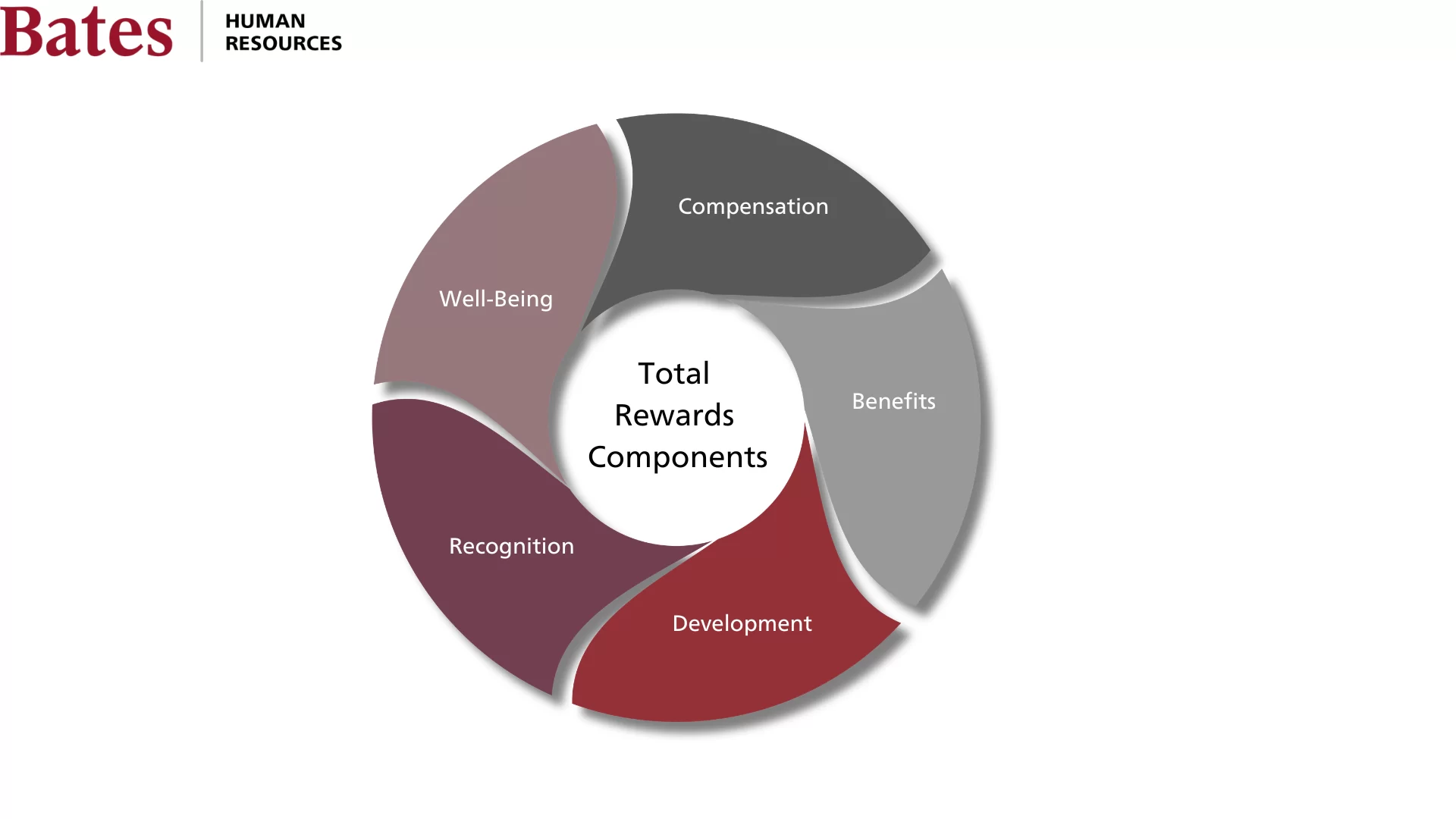
+Bates College Total Rewards Model
| Compensation | – Wages for work performed – Sick pay – Vacation time and personal time off (PTO) – Holidays and staff appreciation days |
| Benefits | – Retirement (9% Bates contribution into 401(a) pension plan. Up to 3% matching contribution into 403(b) retirement plan) – Health insurance (medical, dental, vision) – Paid parental leave, Family Medical Leave Act (FMLA), Maine Paid Family Medical Leave – Wage replacement insurances (life, long-term disability [LTD], short-term disability [STD], accidental death & dismemberment [AD&D], etc.) – Dependent Higher Education Benefit Program (the Rowe Fund) – EAP: Employee Assistance Program – Computer Purchase Program – Bates Health Fair – Vaccination clinics |
| Development | – Education assistance (employee tuition reimbursement) – Certifications & trainings – Conferences – Campus lectures, performances, & workshops – Committees & working groups – Supervisor Success Series – Training modules – Career networking and mentoring |
| Recognition | – Enrichment Week – HR Newsletter: years of service & employee spotlight – Annual holiday party – Individual department honors – Harward Center campus leadership awards – Faculty awards and honors |
| Well-Being | – B Well Program – Library Perks: park & museum passes, and more – Wellness Ambassadors & Well-Being Committee – Campus grounds & athletic facilities |
REFERENCE GUIDE: For more information on the terms and concepts used, please see the Glossary of Terms located at the bottom of this page.
Compensation Program Development
How the Current Program Was Developed
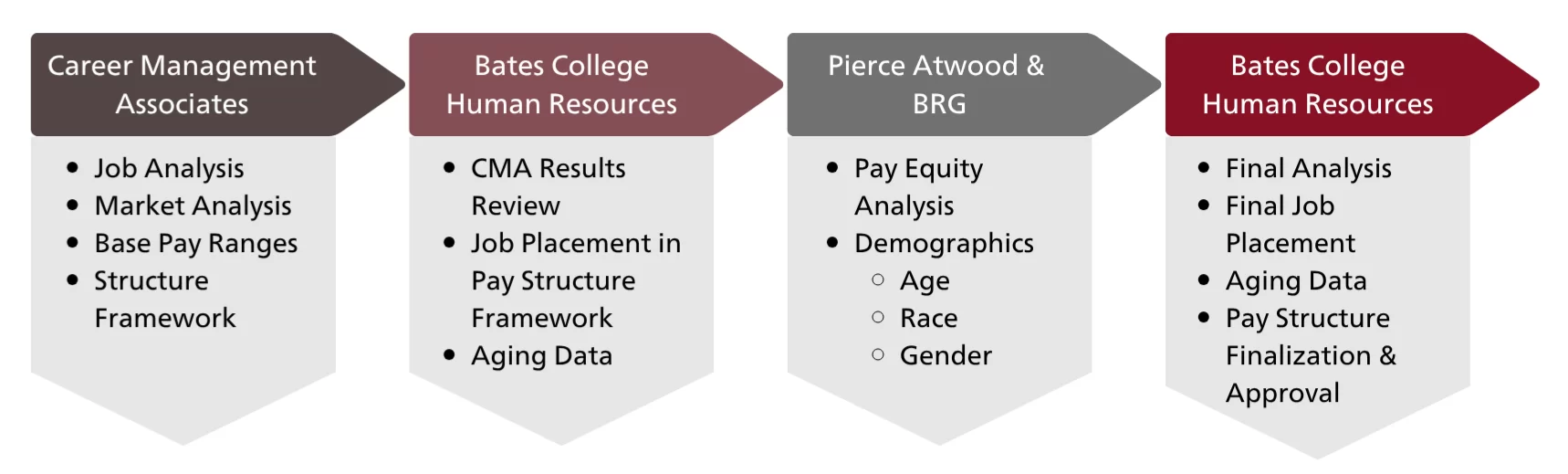
Bates College Human Resources partnered with Career Management Associates (CMA) to begin the work of developing a new pay structure for budgeted exempt and non-exempt staff positions. CMA performed job and market analysis on a range of the college’s positions to determine the essential compensable factors and competitive market value for each. This analysis established base pay ranges and provided the framework to finish slotting each of the college’s staff positions into the pay structure.
To ensure legal integrity and fairness, Pierce Atwood and Berkeley Research Group (BRG) conducted a comprehensive pay equity analysis on demographics such as age, race, and gender. Following these foundational steps, the HR team has continuously refined the pay structure by updating compensation data to align with market trends. We regularly collaborate with department leaders to refine internal leveling, ensuring every role is accurately positioned within our organizational pay structure.
Base Pay Structure – What It Is & How It Is Used
The base pay structure serves as a standardized framework for both exempt and non-exempt positions. This structure is market-informed and guided by the compensation philosophy, with each regularly budgeted position assigned to a specific salary grade based on external market value and internal job value comparisons. In practice, this framework allows us to:
- implement equitable and competitive hiring ranges
- guide professional development
- perform annual benchmarking
- consistently monitor pay trends across departments, maintain internal equity and proactively minimize pay compression, ensuring our compensation remains fair and sustainable.
Compensation & Classification Program Administration
Position Descriptions & How Positions Are Classified
Position descriptions (PDs) are the foundation of compensation and classification decisions. The PD documents the key accountabilities and primary responsibilities of a role. While comprehensive, the duties, responsibilities, and activities listed are not exhaustive. Activities and duties may change or expand over time as the college’s needs evolve. Positions are classified based on the following objective requirements of the role rather than the individual who may fill the role:
- Complexity and scope
- Decision-making impact to the department and/or college
- Supervisory/management responsibilities
- External market value
- Internal value of role
- FLSA exempt/non-exempt status
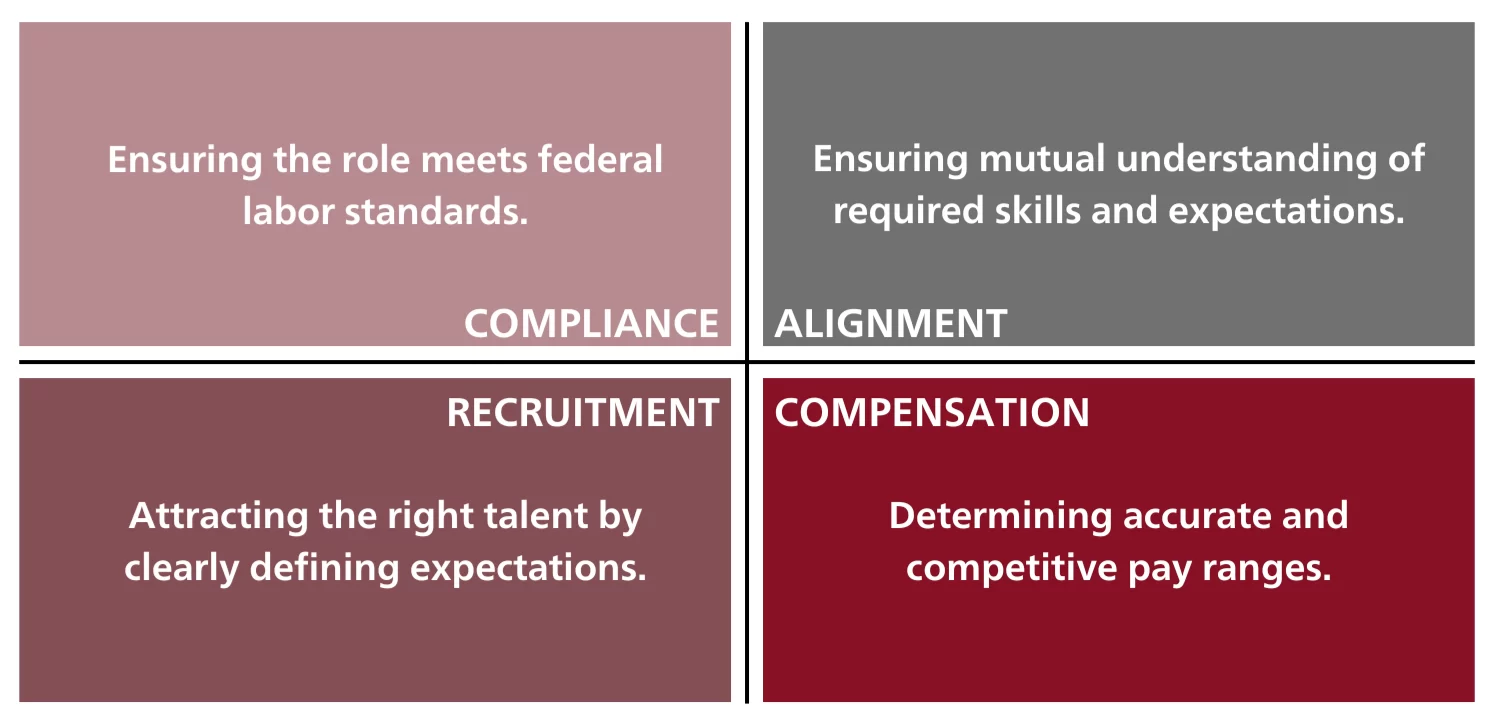
If the key responsibilities and duties of the role change by more than 20%, it is the responsibility of the manager to update the PD accordingly, subject to evaluation and approval by the HR Compensation & Classification Team. A well-crafted PD is more than just a list of tasks; it is a foundational tool used for Compliance, Alignment, Recruitment, and Compensation:
Determining Base Pay
Employee pay is targeted between the minimum and midpoint of the pay range for the salary grade their position is assigned. Pay may fall between the midpoint and the maximum depending on details specific to the position and employee. The factors which determine base pay are as follows:
- Prior related years of experience and qualifications of the employee or candidate
- Time in role
- Internal equity considerations – for the role and incumbent
- Salary grade of role
- Budgetary parameters
Glossary of Terms
- Aging Data: Adjusting historical market compensation data to more accurately reflect its value at the present time.
- Benchmarking: The practice of comparing an internal position, group of positions, or full pay structure to external market data points to determine competitiveness.
- Compensable Factors: The criteria for determining job value. These are specific, measurable qualities of a job which add value to the college and for which it is willing to pay.
- Exempt: Positions that are “exempt” from the overtime provisions of the FLSA. Employees in these positions are generally paid a set salary to perform specific professional, administrative, or executive duties and do not receive overtime pay for hours worked beyond 40 in a workweek.
- FLSA: Enacted by Congress in 1938, the Fair Labor Standards Act established standards for minimum wage, overtime pay, recordkeeping, child labor, and employment categories (exempt; non-exempt) for U.S. employers.
- Hiring Range: A subset of the full pay range where pay is targeted for new employees. This allows the college to offer competitive starting pay while leaving room within the full pay range for the employee to grow in their role.
- Internal Equity: The practice of ensuring that employees performing similar work with similar levels of responsibility and experience are paid fairly relative to one another across the college.
- Leveling: Determining the appropriate salary grade for a position. This is done by analyzing the job description (not the person in the job) to ensure the role is placed correctly relative to other positions at the college.
- Non-exempt: Employees in these positions are paid for all hours worked and must receive overtime pay for any hours worked over 40 in a single workweek. Per the Department of Labor, all jobs are considered non-exempt until proven otherwise.
- Pay Range: The full span of compensation for a specific salary grade, defined by a minimum, a midpoint, and a maximum value. The range allows for salary growth as an employee gains experience and progresses in their role.
- Relevant Labor Markets: The external talent pools the college competes with for employees. Depending on the role, this might be other higher education institutions, non-profit organizations, or other industries within Maine or relevant geographical area.
- Salary Grade: Each budgeted position is assigned to a distinct level within the college’s compensation structure. Each grade groups together jobs with similar levels of responsibility, complexity, required skills, and market value.
- Slotting: The process of determining a position’s salary grade by comparing its responsibilities and requirements to established internal roles when direct external market data is unavailable.
- Total Compensation Statement: A personalized document that illustrates the full value of an employee’s compensation package. It goes beyond base salary to include the college’s contributions to health insurance, retirement plans, and other benefits. Employees may find their statement on Garnet Gateway.
Key Compensation & Classification Contacts
Patty A. Rooney
Associate Vice President for Human Resources
Human Resources
207-753-6935
Melani G. McGuire
Director of HR Operations & Compensation
Human Resources
207-786-8265
Montana K. Kalian
Compensation & Classification Analyst
Human Resources
207-753-6964